
Chag Circuit: Tu B'Av
the love itself

Do you want to get to know me? Okay, then. Let’s give it a shot.
About two and a half years ago, in the midst of an annihilating heartbreak, I started obsessively reading Maggie Nelson’s Bluets, a small book of 240 poetic paragraphs about the color blue, over and over, hundreds and hundreds and hundreds of times. When I woke up, when I went to bed, during meals, in between teaching classes. My physical and digital copies were so littered with highlighter that the notation became entirely useless in its ubiquity. To avoid being parted from the book during commutes, I listened to the short audiobook on a loop during every drive to work or to the store for months. It is, by multiple orders of magnitude, the book I’ve read the most times. I imagine the count is well into four digits.
Bluets is a weird book. I’m an expert in it, and I find it very hard to explain, which is one of the reasons I’ve mostly kept my feelings about it to myself. Nominally, it’s an organized poetry-prose collection written from the perspective of someone obsessed with the color blue. And it is about that! But it’s also about longing, sadness, desire, love, sex, grief, and loss. It’s about watching the speaker work through a well of feeling so full and awful and desperate to be worked through. It puts words to the process of processing that I’d never seen before, showing all the steps of the math problem, and though I certainly wouldn’t describe the book as a narrative where a heartbroken person is healed by the end, it does lay out a bit of a map. It’s somehow a better guidebook for dealing with misery than any self-help book out there, without being in any way openly instructional.
It’s miraculous. Or, better said, it was my miracle. Whatever imagery you want to use — the bottomless pit, the spiral, under the crashed tidal wave — I was in it, alone, and then this book appeared, and there was something else in there with me.
I was singularly focused, in my Bluets era. For those months in 2023, I didn’t read anything else. I didn’t watch movies. I don’t remember listening to music. All of my thoughts were filtered through this tiny book. It was the only thing that made any sense to me.
There are two existential problems with pain: first, it indicates that something inside you isn’t functioning properly, that there is a problem. But secondly — and, I’d argue, often worse — is that it is only contained inside you. There’s no way to get it out, to show it, to share it. It isolates, in that it will never be fully understood by another. You can sit in front of a person for hours and explain to them (exclusively through metaphors, as that’s our only way of describing pain) what it feels like, over and over, in as many ways as you can think of, but it’ll never fully work. You can get close, but unless you can transpose their consciousness into yours, they’ll never really know. And you know that.
Bluets was so close to my pain. So close. I’ve never seen anyone get closer, before or since. And when you’re separated from everyone, from everything, you’ll grab onto anything within reach. Driftwood in the ocean. It’s the only way to get a breath.
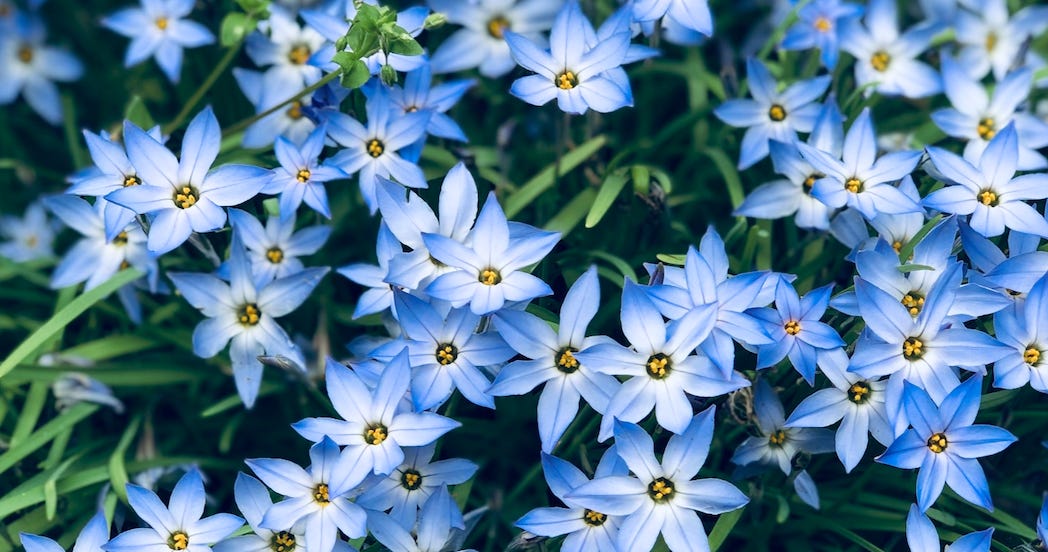
Like most dense works of writing, Bluets has that magical element of revealing something new each time you reread it. Every day of the spiral, a different line would stick out, catching me off guard. On my way to teach one afternoon, I had to pull the car over to the side of the road to cry after hearing the audiobook narrator say, “35. Does the world look bluer from blue eyes?” despite having heard it every day for weeks. It knocked the wind out of me, I couldn’t get in enough air, and I was driving snow-covered roads in the middle of the woods and couldn’t see through the tears. Head on the steering wheel, half in a shallow ditch, I clicked the fifteen-second rewind button on the recording over and over, trying desperately to work through how much of my situation was because I had ignored what I hadn’t wanted to see.
I didn’t know if the world looked bluer from my blue eyes, but it was a question worth asking, finally. It was the first good question I’d heard all day.
Anyway, the constant Bluets reading lasted about four months. My circumstances changed, and the oxygen it gave me I started getting on my own again. I imagine, when the next heartbreak comes — and it will, oh boy, it will — I’ll hook myself back up to it again, but I doubt it will be the same experience. Some drugs we develop too much of a tolerance for, no matter how much we need them, and I’ve never given myself a long enough break from the book to get fully clean.
It’s a shame, because that first time really had a concentration only found in a laboratory setting. Like on that first day, when I read paragraph 36, and knew that this book was going to live in my jacket pocket from then on:
“36. Goethe describes blue as a lively color, but one devoid of gladness. ‘It may be said to disturb rather than enliven.’ Is to be in love with blue, then, to be in love with a disturbance? Or is the love itself the disturbance? And what kind of madness is it anyway, to be in love with something constitutionally incapable of loving you back?”
To be in love with something constitutionally incapable of loving you back.
I thought about this a lot.
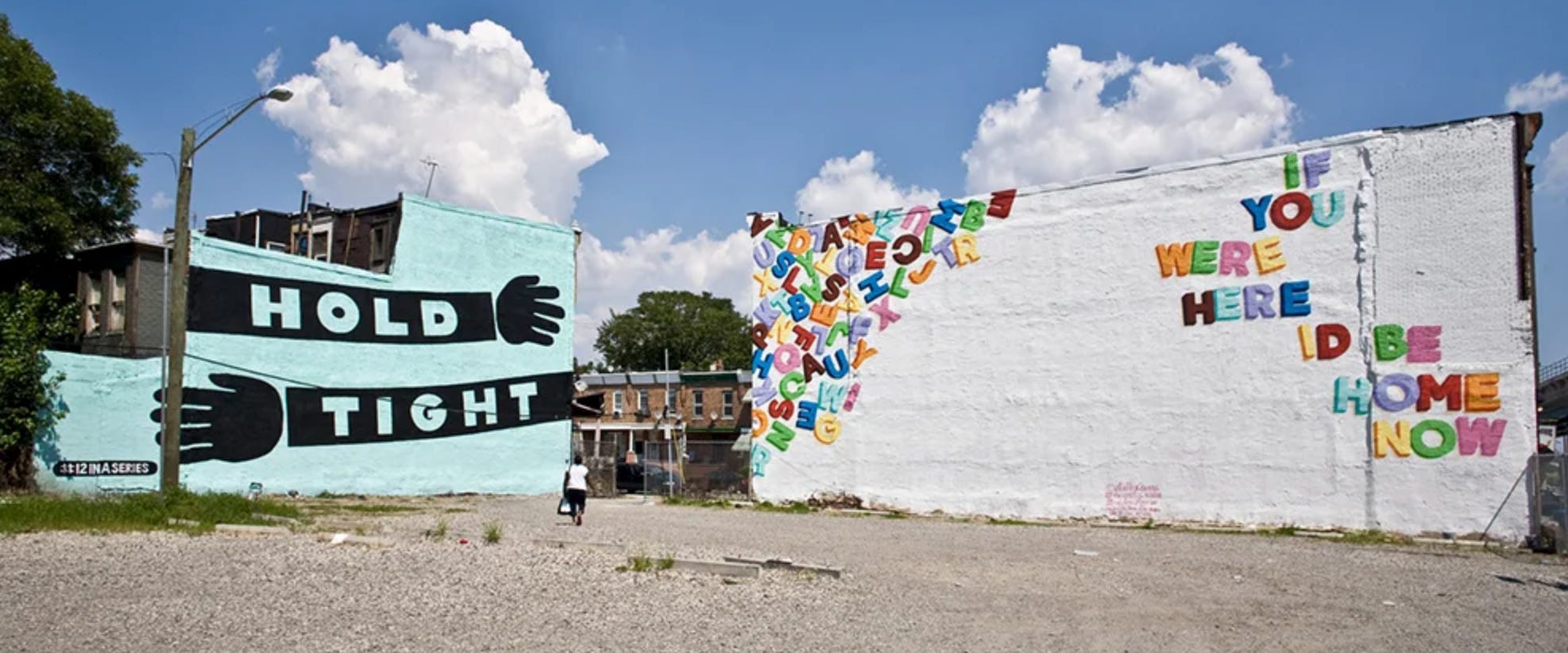
I’m quite certain the first time I fell in love wasn’t with another person, but with a place. This is the only way I can make sense of my relationship with Philadelphia: in love.
I understand that this sounds hokey. Sometimes reality is hokey.
In love with Philadelphia. Real love, romantic love, not surface level or juvenile but true. Maybe truer than love can be when it’s with another person — but more on that in a moment.
Being in love is a hazy, borderless thing, so it stands to reason that my explanation will be the same. I’m not even sure what I mean by “Philadelphia.” The physical space on the planet? The place plus the collective people? The history? A reductive, generalized story of the last four hundred years plus the space but minus the people? My own memories, or my family’s connection?
I don’t know — or, I suppose, I know it when I see it. A word without a true definition, “Philadelphia.” Like “love.”
I don’t remember when it happened, but I imagine I was quite young, when the idolization turned into something more genuine. At the time, I’m sure I couldn’t identify the phenomenon for what it was — I only really understood what this type of love felt like early in my twenties, and could then map it onto something I already had in my life from much earlier.
I’m stating now, as a ridiculous but true fact: the feeling of romantic love I can feel for other people is the exact same feeling I have for Philadelphia. It’s not that it’s close: it’s the exact same.
There is something that happens when your romantic development is shaped by falling in love with a metro area: you see being in love as something that moves entirely inside-out. It’s something I feel, from me, and it’s unchanged by a lack of response. Philadelphia can’t talk to me. It can’t hold my hand. There’s nothing I can ask from it, nothing it can give me. It doesn’t care if I’m there — it doesn’t care. The fact that I exist has no meaningful effect on its existence, one that has survived for hundreds of years before me and will hopefully continue for much longer after me.
To riff off of Nelson’s form: what does it mean, then, to understand the default of being in love as not a reciprocated phenomenon?
I love it, and not in spite of this. What it does is irrelevant. The fact that it can’t feel anything for me (being, you know, a place) has no bearing on what I feel. The love comes from me. I have no control over it. And it will continue like this, probably forever.
There are so many things I imagine I’ll love forever.
Maybe this whole thing screwed with my head, understanding love like this. Maybe I’m wired wrong now, or maybe I’m enlightened. I don’t know. I know that one-sidedness is not a deal breaker for me. How could it be? The most important relationship I’ve ever been in is with an entity that doesn’t experience consciousness.

Despite all of this, despite how it sounds, I don’t think I’m quick to lionize people, things, or places. Lionize, or villainize. I actually think I’m pretty healthy in that regard; there’s a strong undercurrent to my perception of the world that reminds me how complicated everything is, how little I know, and how important it is not to assume. Not to make things grander than they really are. “What a treacherous thing it is to believe that a person is more than a person,” says John Green, in a line that’s stuck with me since I was a kid.
So I don’t think I have poor judgment in these things, though I imagine most people would say that. I do think that when I see something out in the wild — see a person or see a place that I connect with so strongly — I reach out and grab onto it very, very tightly. Because I know there are limited opportunities for belonging in this world.
And I want them. I really want them. I want to belong.
And though I don’t think loyalty is necessarily a positive or moral attribute, I do think I have that bent. I’m just the type of person to hold on tightly, and stick out any storm, because I don’t catch those things coming around very often.
When you find things that really see you, really get you in ways that so few other things have, you want to dedicate yourself to them. People. Places. Poetry books.
A while ago I was rereading Bluets, and a new line struck me, one that had never jumped out before: “229. I am writing all this down in blue ink, so as to remember that all words, not just some, are written in water.” I imagine that is also what I’m doing here, with this project. In many ways, I am writing to let go.
For most of my life, I have operated on this flimsy, mildly sociopathic rule of not allowing people in my head: I reveal enough nonsense to allow the illusion that I’m sharing, so I can keep the real stuff to myself. This has been a less-than-covert strategy to a number of my friends, some of whom have straight-up told me I don’t share on equal measure to them. A close friend once yelled at me in an empty parking lot that they barely knew me, even after many months of living together. In a room with my friends, I talk constantly, but I say very little. It’s calculated.
After a certain amount of output, people stop asking deliberative questions.
It would be easy to say it’s fear, a fear of judgment, but I don’t think that’s it. I wish it was; people have sympathy for fear. It’s probably disinterest — disinterest in explaining myself, disinterest in being questioned, disinterest in keeping a public record. I wanted, and want, to retain the ability to disappear, and disappearing gets harder when people can guess where you’d fuck off to. I maintain that these are all reasonable desires, but reasonable doesn’t and shouldn’t mean absolute, and I was keeping them absolutely.
But I am trying now. The last few years, I have been trying.
So I ask again: do you want to get to know me?
To understand why I do some of the things I do, how I love who and what I love, looking to what I am with Philadelphia will reveal some of the answers. Philadelphia is the blueprint, the original sin. The core equation to predict the way I see the world was written there. Extrapolate out, and you’ll see it too. Right now I’m writing in water, like Maggie Nelson said, but writing is writing, and I’m writing to be known. To be known, to be seen, and then to let go.
Tu B’Av marks the final unique holiday of the Chag Circuit year. In a few weeks, we’ll have our last installment of the Shabbat miniseries, where we’ll officially finish this project and discuss the future of this silly blog.
If you or someone you know is experiencing apocalyptic heartbreak, I suggest picking up Bluets from the library, Bookshop.org, or your local independent bookseller. Or, you know, call me. I have a bunch of copies.
Mmmm. Your writing gives me chills.
I am, once again, in opposite land. I know people deeply, and they know me deeply. I engage with art that is wildly vulnerable in a variety of mediums and I put all my goopy stuff there for people to see.
However, like you, I grab on tight. Strong hands, you know?
There's a lot to relate to here. I am glad that I get to know you, you know, to whatever allowable extent!