
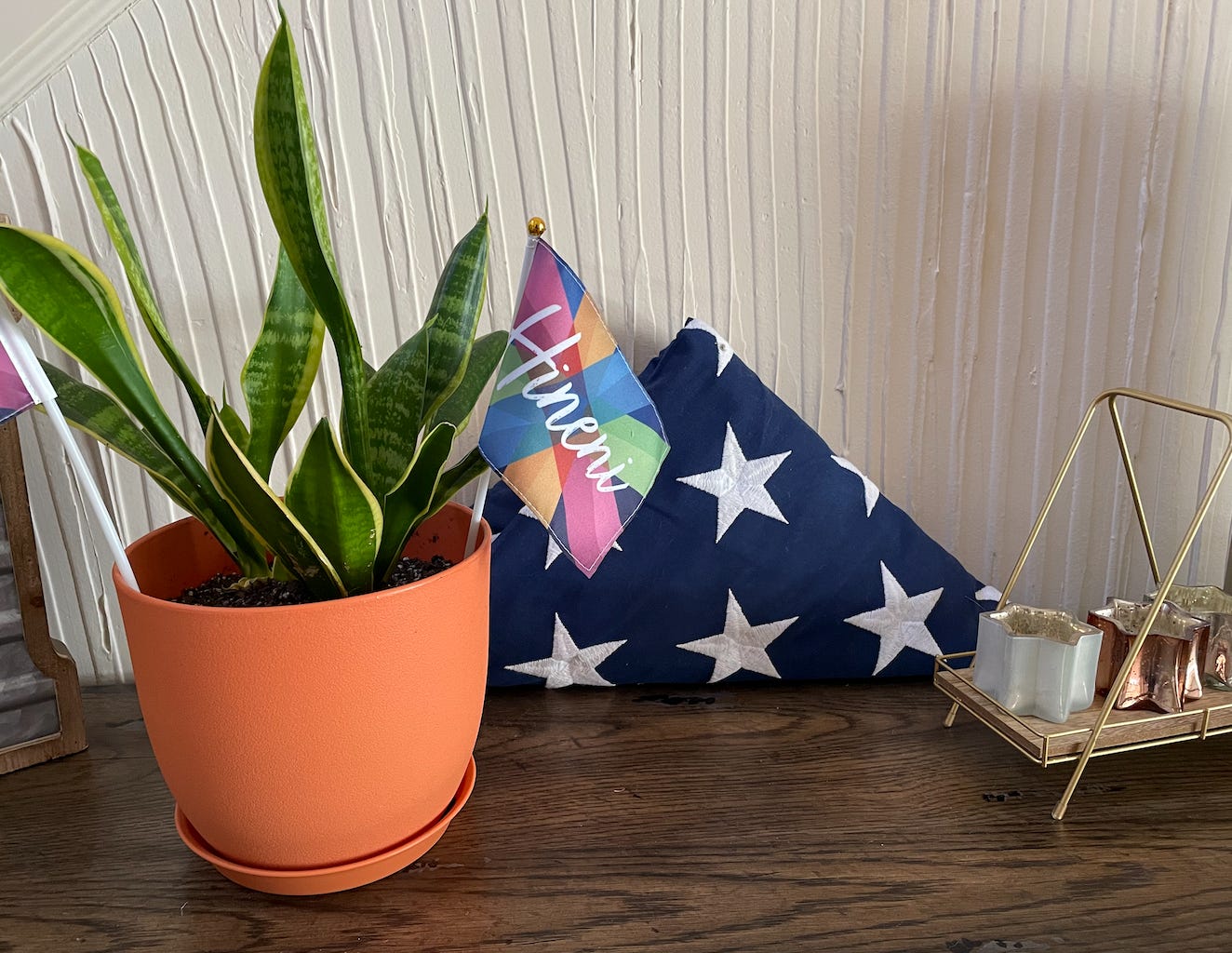
5786: Hineni
and you're here with me
I’m feeling particularly crumbly this morning. In the past seven days, I have witnessed three moments of incredible connection. Maybe telling you about them will help.
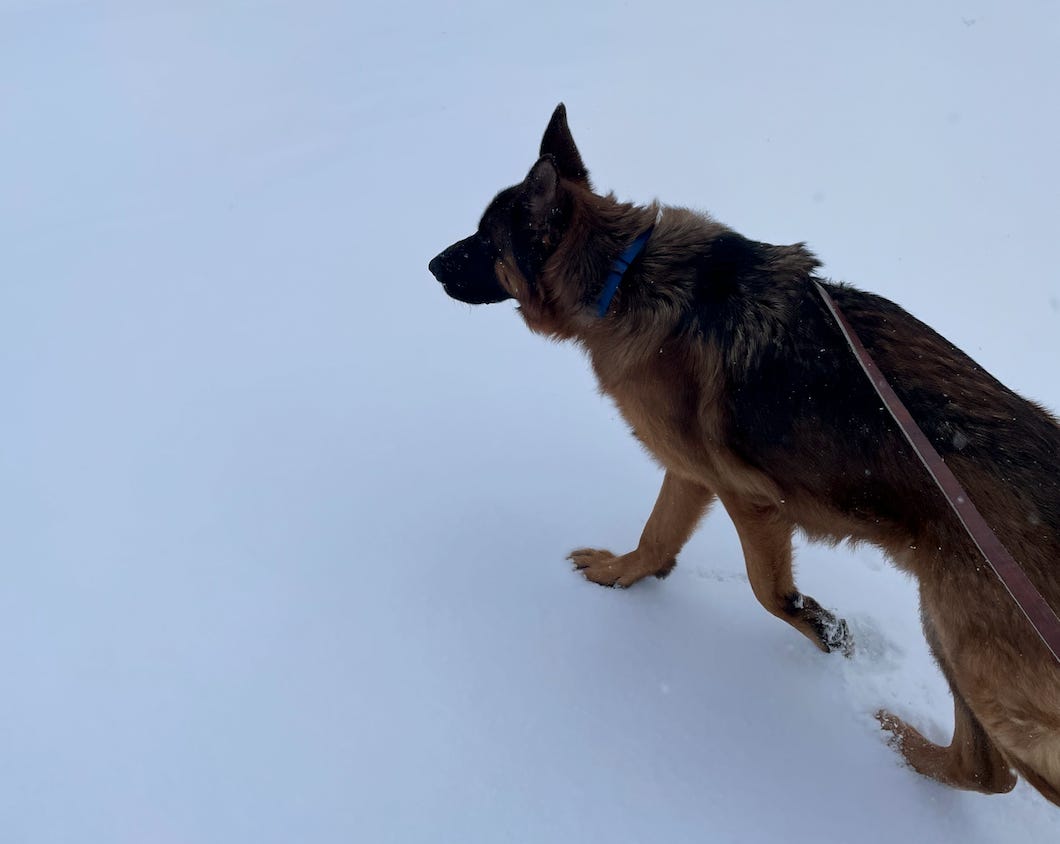
I have found myself living with a dog again. A German shepherd who is more horse than canine, and with whom I’ve taken to roaming around the local streets most middays. We meet a lot of other dogs this way, with a variety of personalities, but it’s been so cold in the Midwest lately that I haven’t gotten much of a chance to speak to the owners. Too much of a rush to get back inside.
Except for Monday. Monday, I was walking up one of the side streets and a woman with her own animal was walking in the cross-direction, but she stopped upon seeing my charge.
“Is that a German shepherd?” she asked me.
“It is.”
“We lost our German shepherd last year. Is he friendly?”
“He’s very friendly.”
“Can I pet him?”
“Of course you can.”
This woman walked up to the dog — her dog was off smelling something, I assume — and touched his little (read: huge), soft head, and her fingers sunk into his coat, and I watched as tears start welling up in her eyes. Everyone was quiet, the whole world was quiet, and after a minute, she let go, and thanked me, and walked off.
A stranger in the street, standing not two feet away, cried in front of me, during an interaction that was shorter than the song I’d left playing through my headphones.
Obviously, when a dog does a mitzvah, it should be remarked upon, and so I am remarking it. What a strange kind of moment: to allow yourself to see the dead walk again. To hold a ghost. You’re not gone, one might say. You’re not gone, because I could never forget you.
Smash cut to Tuesday. The dog was home, but I was at work, and had a curious conversation with a fellow teacher.
I am finding it difficult to put into intelligible words what happened between checking into work and setting my bag down in my classroom. My coworker was sad — she wasn’t telegraphing it, but I try to pay attention — and without much warning she cryptically asked if she could show me something. I like her, and I was early, and also there was no universe I’d say no, so as we walked down the hallway she pulled out a phone and clicked on a piece of music. A prayer, using a tune I hadn’t heard before, backed by a piano.
We listened in silence for a long minute, and then she asked if I knew why she was playing it.
I had a guess. This woman used to be a professional singer, but medically isn’t able to sing anymore, and I told her that I thought it was her on the recording. I was right; the voice was hers from more than a decade ago, and she had even written the music. We listened through to the end.
Not to be immodest, but I have a fairly good sense of what to say to someone who is having a hard moment. Call it a perk of being raised by a rabbi. More often than you’d think, the trick is to say as little as possible. Because they already know everything you have to say. And because they want to speak.
And what she said was: “I really needed you to hear that.”
And what she meant was: “I needed a witness.”
It’s not that far from the woman I met on the street, literally or metaphorically. She needed to see the ghost of something gone. She needed that, and she needed someone else to see the ghost. To prove that it was there, to prove that it was real. She wanted me to see the context of who she was, who she had been.
It isn’t enough to know it’s true. You can tell yourself it is, but it doesn’t work. Someone needs to bear witness.
I told her that her students would make her day better. I told her the winter feels endless in both directions, to misquote Kaveh Akbar, but that it does end. And I told her that I liked her song.
And that’s all I said. Because it wasn’t about that. She’d needed a body in the room, and I’d happened to have one. She showed me. I saw. And that was what needed to have happened.
There’s one more, to make this a clean trio. One more, from Friday night.
I went to Tot Shabbat with my cousins. Kiddush. It was sweet, and being that I work in that building, it was familiar. Not that all synagogues aren’t familiar to me; I am annoyingly comfortable in any building with a big menorah stapled to the side of it. Always have been. But this one I knew where the bathrooms were.
Kid services were cute. There were maracas, and everyone sat in a circle, the youngest of our crew paid close attention to the Shabbat Dinosaur book. Afterwards, we sat in the event hall to eat dinner, and almost immediately the gaggle of kids broke out in tag or hide and seek or let’s-throw-shoes-like-footballs, if one can even call that a game. A swarm of children, racing around.
I was sitting at one of the round tables talking about various things to my cousin, the mother of a few of the aforementioned swarm, and from about twenty feet behind her, we heard a kid take a fall. A little girl, flat on her back, a couple of kids standing over her acting concerned. My cousin turned, looked, waited a beat, and then bolted up and over to this random kid. I believe she warped there; despite looking straight at her, I watched her go from sitting in her chair to carrying a strange child with no inbetween motion.
She held her, she comforted her, until the child’s mother arrived a few seconds later, and then my cousin handed her over.
It was the instinct of it. Seeing a vacuum, seeing a void, and filling it. And it doesn’t particularly matter who you are, or whether or not you know the child’s name. It just matters that you’re willing to be there.
Someone has to get you, so I’ll get you. Someone has to hold you, so I’ll hold you.
That’s the kind of person she is. She’ll get you, because she’s here. She’s here. She’ll look at you, and she’ll witness whatever you need witnessed, because she’s in the room. And I suspect she hopes that you’ll try to see her too. So she isn’t alone either.
And once that’s all done, she’ll find your mom.
An ex once said to me, “You know, if you showed flaws, you’d be more lovable.” This is a bizarre statement to me, because I think I project my flaws on billboards down the highway. But regardless of their relevance to that doomed relationship, I think the sentiment is broadly true.
We need to stand in front of each other. We need to say, out loud, that we are hurt. We need someone to hear it. It doesn’t matter who it is — a stranger on the street, a coworker, someone else’s mom — as long as they’re here with us. It’s how we build bonds. It’s how we fight the loneliness of a long dark, of a cold winter. We say: here I am. Please see me. Please stand next to me while I cry, so I don’t have to do it alone. So someone else knows what happened. So I’m in your story too.
And we need to witness. That’s what love is. Bearing witness. Love is saying: it’s safe to let me know you. Love is saying: here I am. I can see you. You’re real to me.
It’s a long, cold, dark winter. And it keeps coming, and it feels endless. But it’s not forever. And in the meantime, I watch as we try to be there for each other. And it helps. You’re here. I’m here. And I’ll do my best to see you.
Welp, I need to remember not to read your posts in between meetings - now I'm wiping makeup off my cheeks.
Here you are. And we are glad.